
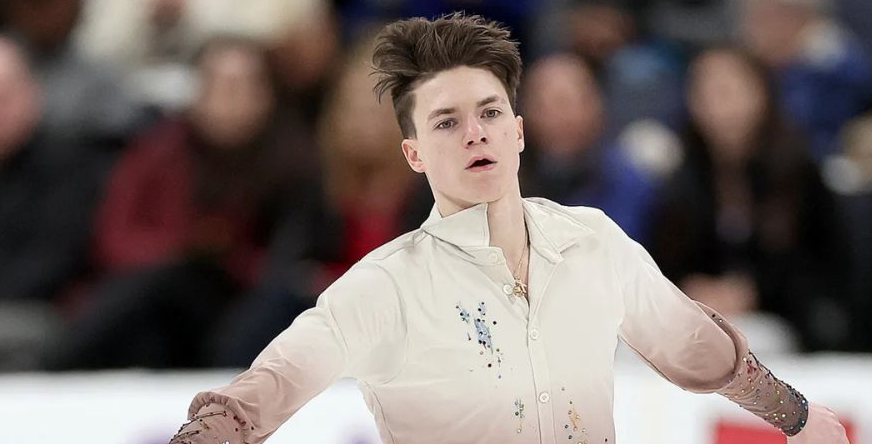
The arena in Milan fell silent. Not the anticipatory hush that precedes every Olympic skater, but something deeper—a collective holding of breath. When Maxim Naumov pushed off into his first glide at the 2026 Winter Games, he was not alone on the ice. Somewhere between the strokes of Chopin’s “Nocturne No. 20,” between the quad Salchow and the triple Axel, skated the ghosts of two people who had taught him everything: his mother and father .
One year and twelve days earlier, Evgenia Shishkova and Vadim Naumov—world champion pairs skaters, beloved coaches, and the architects of their son’s Olympic dream—were among the 67 souls lost when American Airlines Flight 5342 collided with an Army helicopter and plunged into the Potomac River . On February 10, 2026, their son took the Olympic ice they had dreamed of together. His performance was not merely a competition. It was a living memorial, a conversation across an impossible divide, and a narrative of transcendent resilience that left an arena of 12,000 spectators weeping and standing as one.
The Legacy: A Family Skating Dynasty
Long before the tragedy that would capture the world’s heart, the Naumov name carried weight in figure skating’s highest echelons. Vadim Naumov and Evgenia Shishkova were two-time Olympians for Russia, reaching the peak of their sport by claiming gold at the 1994 World Figure Skating Championships . They married in 1995, retired from competition three years later, and embarked on a new chapter as coaches, eventually founding a youth academy at the Skating Club of Boston .
Maxim was born into this world in 2001, the child of Olympians who understood that greatness required not just talent, but sacrifice. “Having role models be right there in the house, at the rink, everywhere,” Maxim would later recall, “they inspired me to want this dream” . The family pursued that dream together, through early mornings, through disappointments, through three consecutive fourth-place finishes at U.S. Nationals that left them all searching for answers .
In January 2025, after Maxim finished fourth yet again at the U.S. Championships in Wichita, Kansas, Vadim sat his son down for a 45-minute conversation . The patriarch laid out a plan for the Olympic season ahead: change the mindset, get more consistent, be resilient. It was emotional, productive, and—unbeknownst to either of them—final. Vadim and Evgenia stayed behind in Wichita to participate in a youth development camp while Maxim flew home .
Days later, the plane carrying more than two dozen members of the figure skating community crashed. The tight-knit world that had raised Maxim lost 28 of its own . And Maxim lost everything.
The Preparation: Training Through Heartbreak
In the immediate aftermath, Maxim could not imagine skating again. “I just wanted to rot, basically,” he confessed to The Associated Press, describing those first days when getting out of bed, answering the door, and checking the mail felt like insurmountable tasks . The photos he would later clutch so tightly were initially unbearable to look at; the thought of watching videos of his parents still reduces him to tears .
But grief does not follow a straight line, and neither did Maxim’s path back to the ice. “I had those moments where I just froze,” he said. “I didn’t know what to do. I said, ‘Hey, this is such a crucial and pivotal moment in my life. If at this moment I don’t take on the responsibility, then I’ll look back forever on this moment, at my most vulnerable, at the most intense, and I know that I did not step up'” .
His parents had 45 students at their academy. Maxim’s immediate reaction was to step onto the ice and work with all of them . It was a lifeline. Coaching his parents’ skaters, he found purpose in the very thing that threatened to consume him.
That summer, in a spontaneous decision that would shape his Olympic destiny, Maxim flew to Courmayeur, Italy—a mountain village at the foot of Mont Blanc—to work with renowned choreographer Benoît Richaud . He arrived without a plan, without music, without any idea what his programs would become. “I came to Benoît and I said, ‘Hey, I’m not really sure what I want to do this year. I want do something great'” .
Richaud began playing tracks from his phone. The second option—Chopin’s “Nocturne No. 20″—stopped Maxim cold. “Immediately, there’s a feeling that you know that this is the one,” he said . For his free skate, they searched for an entire session before landing on “In This Shirt” by The Irrepressibles, a haunting ballad whose lyrics seemed written for him: “I am lost in a rainbow, now our rainbow is gone” .
Maxim ended up staying in Courmayeur for six weeks, crafting both programs from scratch in a rink with stained-glass windows, far from the world and its demands. The short program became a remembrance; the free skate, a looking toward the future . “In those moments, you really do feel super connected to the music,” he explained. “There’s nothing else. You can’t hear the crowd, you can’t hear your blades on the ice, you’re just in it” .
The road to Milan was neither smooth nor certain. At the Legacy on Ice benefit in Washington just weeks after the crash, Maxim skated a solo to a song about his parents’ hometown of St. Petersburg and collapsed onto his knees at the end, overcome . “I can count on one hand how many times that I felt that,” he said. “Those moments are special, and they change you. They changed my entire relationship with skating” .
Competition results trickled in—ninth at Lombardia Trophy, ninth at Grand Prix de France, then a breakthrough win at the 2025 Ice Challenge in Austria, where he broke the 90-point barrier for the first time in his short program . But the real test came at the 2026 U.S. Championships in St. Louis, where Olympic spots hung in the balance.
Everyone in the arena knew his story. When Maxim took the ice for warm-ups, the crowd roared. That night, he delivered an emotional short program, and when he left the ice, he held up a photograph of himself at age three, holding hands with his mother and father on ice for the first time . He kissed the photo and broke down in the kiss-and-cry. “I really just wanted them to be present in the Kiss and Cry,” he said. “That’s such an important moment” .
The night before the free skate, he grabbed another photo and sat with it for nearly 20 minutes. “To just be like: ‘Look how far we’ve come. Look what we’ve done; look at all the sacrifices we made. Everything that we’ve been through, everything that we’ve planned, all coming to fruition'” .
When the final standings confirmed his bronze medal and Olympic berth, Maxim stepped away and sobbed. “I just bawled my eyes out,” he said . He had done it. They had done it.
The Performance: Every Jump a Memory
February 10, 2026. The Milano Ice Skating Arena. Twelve months and twelve days since the crash that stole his parents from the world.
As Maxim prepared to skate, a simple message flashed on the arena’s Jumbotron: “Mom and Dad, this is for you” . In his Team USA jacket, he carried a quote from his father: “Expect the unexpected” . In his hand, he carried the childhood photograph—himself at three, sandwiched between his parents’ beaming faces, standing on ice with skates for the first time .
The music began. Chopin’s nocturne, chosen in that mountain rink half a world away, filled the arena. What followed was something Maxim himself struggled to explain. “I felt like I was being guided like a chess piece on a chessboard,” he told reporters afterward, his voice trembling . “As I was going into one element and another, I didn’t have any fear in my mind, just confidence and ready to go” .
He opened with a flawless quadruple Salchow, followed by a triple Axel and a triple Lutz-triple toe loop combination . The elements flowed not like a competition program but like a conversation—each jump a memory, each spin a prayer. “I felt almost like a hand on my back pushing me forward,” Maxim said .
When the final note faded, Maxim dropped to his knees on the ice. Looking skyward, he whispered words that cameras caught but microphones could not capture. Later, he would share what he had said: “Look what we just did” . He was speaking to his father and mother.
The arena erupted. Twelve thousand people rose as one, many with tears streaming, some still processing what they had witnessed. In the kiss-and-cry, Maxim held up that childhood photograph—the one he had kissed at Nationals, the one he had carried across an ocean, the one that proved this moment belonged to three people, not one .
His score: 85.65 points, a season best, safely qualifying him for the free skate and placing 14th overall . But the point total was never the point.
Among those watching was his teammate Ilia Malinin, the gold medal favorite, who had trained alongside Maxim since childhood. “The strength and the bravery,” Malinin said, “is just so heartwarming for me” . Fellow Olympian Andrew Torgashev described watching Maxim compete: “Fighting for everything, heart on his sleeve, just pouring blood, sweat and tears into every performance” .
Two days later, for the free skate, Maxim returned to the ice. It was not a perfect program. He fell twice on quad Salchows and was uneven throughout . But when it ended, the crowd rose again. Among them was actor Jeff Goldblum, wiping his eyes . Above the kiss-and-cry, a small group waved a homemade sign: “Let’s Go Coach Max!”—students from the academy his parents founded, the academy he now runs .
“Hey, what’s up guys!?” Maxim called up to them, smiling and waving .
Later, reflecting on both performances, he said simply: “To be honest, I just feel proud. I feel proud of the journey that it took to get to this point” .
Conclusion: More Than a Medal
When asked how his parents would have reacted, Maxim’s face softened through the tears. His mother, he explained, was famously anxious during competitions—refreshing score pages, nervous out of her mind, but supporting him always in her own way . His father would have been right there with a hug and the three words Maxim needed most: “I’m proud of you” .
Maxim had come to Milan carrying more than a photograph. In his Team USA jacket, folded beside his heart, was that quote from his father: “Expect the unexpected” . He had learned its truth in the most brutal way imaginable. But he had also learned something else: that resilience is not the absence of grief, but the choice to keep moving through it.
“Skating is a tool for that,” he said. “I think we can all do that. Whatever life throws at you, if you can be resilient and push just a little bit more than you think, you can do so much more” .
In the kiss-and-cry after his short program, Maxim had lifted that childhood photograph high—not as a talisman, but as a testimony. “I wanted them to be in the kiss and cry with me,” he had explained weeks earlier, “to literally share that moment with me, because they deserve it. They deserve to be there, right next to me” .
And they were. In every glide, every jump, every whispered word to the sky, Evgenia Shishkova and Vadim Naumov skated alongside their son. The dream they had pursued together, the dream they had discussed “every day, year after year,” the dream that began when a three-year-old boy first stepped onto ice between his parents—that dream was realized on a February night in Milan .
Maxim Naumov left the Olympic ice without a medal around his neck. But he left with something far more enduring: the knowledge that love does not end with loss, that legacies are carried not in trophies but in the choices we make when everything falls apart, and that sometimes, the most perfect performance has nothing to do with perfection at all.
In the arena that night, a simple truth echoed off the ice where Maxim had skated: some bonds transcend. Some bonds skate on. And for Maxim Naumov, every jump will always be a memory, every program a conversation, and every step forward a step taken for two.