
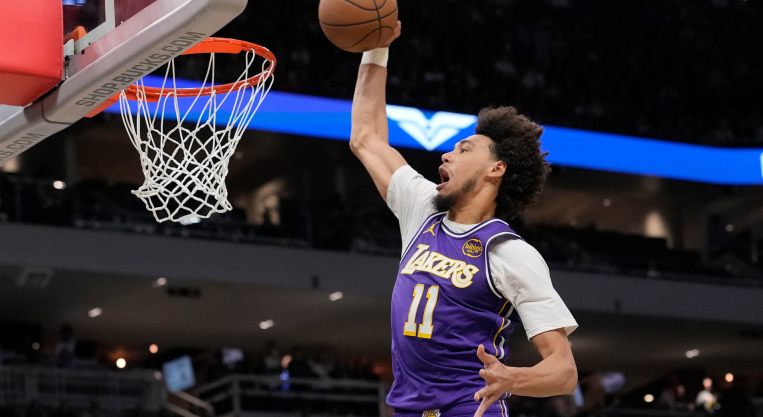
The Intuit Dome in Inglewood hummed with anticipation on Saturday night, but something felt different. For the first time since 2022, the reigning king of the NBA Slam Dunk Contest was not in the building. Mac McClung, the 6’2″ G League phenomenon who had single-handedly revived the event with three consecutive electrifying victories from 2023 to 2025, had officially passed the torch . In his place stood a new headliner: Jaxson Hayes, the 7-foot Los Angeles Lakers center, carrying the weight of the Purple and Gold into basketball’s premier aerial showcase.
The 2026 Dunk Contest marked a definitive shift in the event’s ever-evolving narrative. After three years of the G League underdog era—a period defined by McClung’s viral creativity and relatability—the spotlight returned to NBA star power, albeit of a different variety. Hayes, a rotation player on one of the league’s most famous franchises, stepped onto the floor not just to compete, but to carry a legacy that stretched back to Kobe Bryant’s 1997 victory . The question hanging in the California air was simple: could the Lakers’ big man deliver?
The McClung Era: A Retrospective
To understand the weight of the moment, one must first appreciate the man who chose to sit it out. Mac McClung’s three-year reign was nothing short of miraculous. In an era where NBA stars routinely declined participation—citing injury risk, fatigue, or the impossible weight of social media critique—McClung embraced the spotlight . Standing just 6’2″ in a world of giants, he became a folk hero. The “white guy can jump” narrative followed him everywhere, but it was his sheer inventiveness—the double pogo, the 540-degree slam, the tribute dunks—that won over skeptics.
McClung was not a star in the traditional sense. He spent the majority of his professional career in the G League, toiling for the Chicago Bulls’ affiliate, the Windy City Bulls . Yet in the Dunk Contest, he was untouchable. His victories gave the event a temporary renaissance, a jolt of energy that masked the underlying rot of star absenteeism .
So why did his reign end? The answer, it turns out, was not injury or fatigue, but a strange paradox of his own success. In an interview with HoopsHype, McClung revealed that he had prepared for the 2026 contest, keeping dunks in his back pocket in case circumstances changed. But as organizers circled back to potential participants, a pattern emerged: “People didn’t want to do it if I was doing it,” McClung explained. “I thought it’s best if I just sit out this year and let it be, no matter what” .
There was no ill will—McClung emphasized that the other competitors were “good friends” . But the reality was undeniable: McClung’s dominance had become a deterrent. Rather than scare off competition or preside over a diminished field, the three-time champion graciously stepped aside, accepting a spot in the Rising Stars game instead . The stage was set for a new champion.
The New Headliner: Jaxson Hayes
Enter Jaxson Hayes. At 25 years old, in his seventh NBA season and third with the Lakers, Hayes represented something the Dunk Contest had been missing: size, power, and the unmistakable aura of the league’s most glamorous franchise . The 7-footer averaged just over 17 minutes per game for Los Angeles, but his impact above the rim was undeniable. Heading into All-Star Weekend, Hayes ranked among the league’s top 20 in total dunks with 75 slams on the season—a staggering figure that spoke to his explosiveness as a roll man and lob threat .
For Lakers fans, the hope was palpable. Not since Kobe Bryant won the contest as a rookie in 1997 had a member of the Purple and Gold claimed the crown. Hayes carried that history with him onto the floor at Intuit Dome .
His style stood in stark contrast to McClung’s. Where McClung relied on creativity, contortion, and the element of surprise from a smaller frame, Hayes was built for power. His dunks were designed to intimidate—two-handed throws, tomahawks, and the kind of rim-rattling force that only a 7-footer can generate. In the days leading up to the contest, Hayes offered a tantalizing preview: during a 129-118 victory over the Chicago Bulls, he threw down a between-the-legs dunk reminiscent of Isaiah Rider’s iconic “East Bay Funk Dunk” from 1994 . The basketball world took notice.
But power alone does not win the Dunk Contest. Creativity, execution, and the ability to perform under pressure are equally critical. And for Hayes, the pressure was immense. He was not just competing for himself; he was representing the Lakers on their home floor, in front of a star-studded crowd that expected greatness.
The Supporting Cast: Who Else Competed?
Hayes was far from alone in the 2026 field. The four-man lineup featured a mix of rookies, athletic forwards, and a touch of legacy intrigue. According to pre-contest reports, the participants were tightly grouped in betting odds, with no overwhelming favorite .
Carter Bryant of the San Antonio Spurs entered as the slight favorite at +180, despite averaging fewer than 10 minutes per game as a rookie. Known for his explosive leaping ability, Bryant represented the new generation of unproven but athletic prospects eager to make a name for themselves .
Keshad Johnson of the Miami Heat followed at +320. Johnson, an undrafted second-year forward, had made 16 dunks on just 42 career baskets—a statistical anomaly that screamed “dunker first, shooter second” . His Oakland roots and connection to Bay Area culture would later play a pivotal role in the competition.
Rounding out the group was Jase Richardson of the Orlando Magic, listed at +350. Richardson carried perhaps the most sentimental storyline: he is the son of two-time Slam Dunk champion Jason Richardson, who won the event in 2002 and 2003 . Fans were eager to see if the apple had fallen far from the tree, though Jase had only four dunks in 38 regular-season games .
The format remained classic: two rounds, five judges (including legends Dominique Wilkins, Dwight Howard, Nate Robinson, and Brent Barry), and 90 seconds per dunk attempt . The two highest scorers after the first round would advance to the final.
The Performance: A Night of Promise and Disappointment
When Hayes took the floor for his first dunk, the arena buzzed with anticipation. Lakers fans, draped in purple and gold, rose to their feet. The stage was set for a coronation.
It did not go as planned.
Hayes’ first attempt was, by all accounts, a dud. He gathered a running start from the opposite end of the court, took off from just outside the dotted line, and delivered a straightforward, unremarkable dunk . The judges’ faces said everything. In a contest where creativity is paramount, Hayes had played it safe—too safe. The score reflected the mediocrity.
He rebounded on his second attempt. Throwing the ball to himself off the floor, Hayes went between his legs and finished with authority . It was the kind of dunk fans had hoped to see from the opening whistle. But the damage was done. When the first-round scores were tallied, Hayes’ combined total was not enough to advance. He was eliminated.
The final came down to two former Arizona Wildcats: Keshad Johnson and Carter Bryant . Johnson, the Oakland native, delivered the night’s defining moment when he cradled the ball and soared over legendary Bay Area rapper E-40, following the dunk with a playful “Dougie” dance that sent the crowd into a frenzy . He added a self-lob reverse between-the-legs jam and closed with a running windmill from just inside the free-throw line. Bryant fought valiantly, but Johnson’s showmanship and local flair proved insurmountable. Keshad Johnson was crowned the 2026 NBA Slam Dunk Champion, earning $105,000 and becoming the first Wildcat to win the event .
For Hayes, the night ended in disappointment. He had failed to advance, failed to deliver the statement dunk Lakers fans craved, and failed to bring the crown back to Los Angeles .
Conclusion: Can the Contest Be Saved?
The 2026 Slam Dunk Contest, much like its immediate predecessors, left fans and analysts asking a familiar question: can this event be saved? Mac McClung’s absence created a vacuum, and while Johnson’s victory was entertaining, the broader concerns about the contest’s relevance remain .
The fundamental problem is participation. NBA stars have long balked at the Dunk Contest. The reasons are well-documented: fear of injury, the physical toll of preparation, and the brutal reality of social media, where any failure is amplified and immortalized . Anthony Edwards turned down an invite as a rookie. Zion Williamson expressed interest only if he made the All-Star team—a condition that rarely aligns. This year, Pistons big man Jalen Duren reportedly accepted an invite but withdrew due to a knee injury, leaving the field without its most prominent name .
The result is a contest increasingly populated by rookies, G Leaguers, and role players. Johnson, for all his athleticism, averages just 3.1 points per game for the Heat . Bryant plays fewer than 10 minutes nightly. Richardson has four career dunks. Hayes, the most accomplished of the group, comes off the bench.
Some have proposed solutions. Increased prize money—perhaps modeled after the NBA Cup’s lucrative payouts—could incentivize participation. Currently, the champion earns just $105,000, a pittance for max-contract stars . Others suggest a team format or even tying contest results to draft lottery odds, though such radical changes face significant hurdles .
But perhaps the answer lies not in money or gimmicks, but in perspective. The 2003 Dunk Contest, featuring Jason Richardson, Desmond Mason, Amar’e Stoudemire, and Richard Jefferson, proved that star power is not a prerequisite for greatness . Those four players delivered one of the most memorable contests in history without a single household name among them. The key was simply letting elite athletes compete at their best, free from wheels, gimmicks, or manufactured drama.
The 2026 contest was not a failure. Keshad Johnson delivered moments of genuine excitement, and his victory was well-deserved. But for the event to truly thrive, the NBA must find a way to lure its brightest stars back to the floor. Until then, the Dunk Contest will remain what it has become: a delightful sideshow, but no longer the main event. And for Jaxson Hayes, the lesson is clear: representing the Lakers guarantees attention, but only greatness guarantees victory.